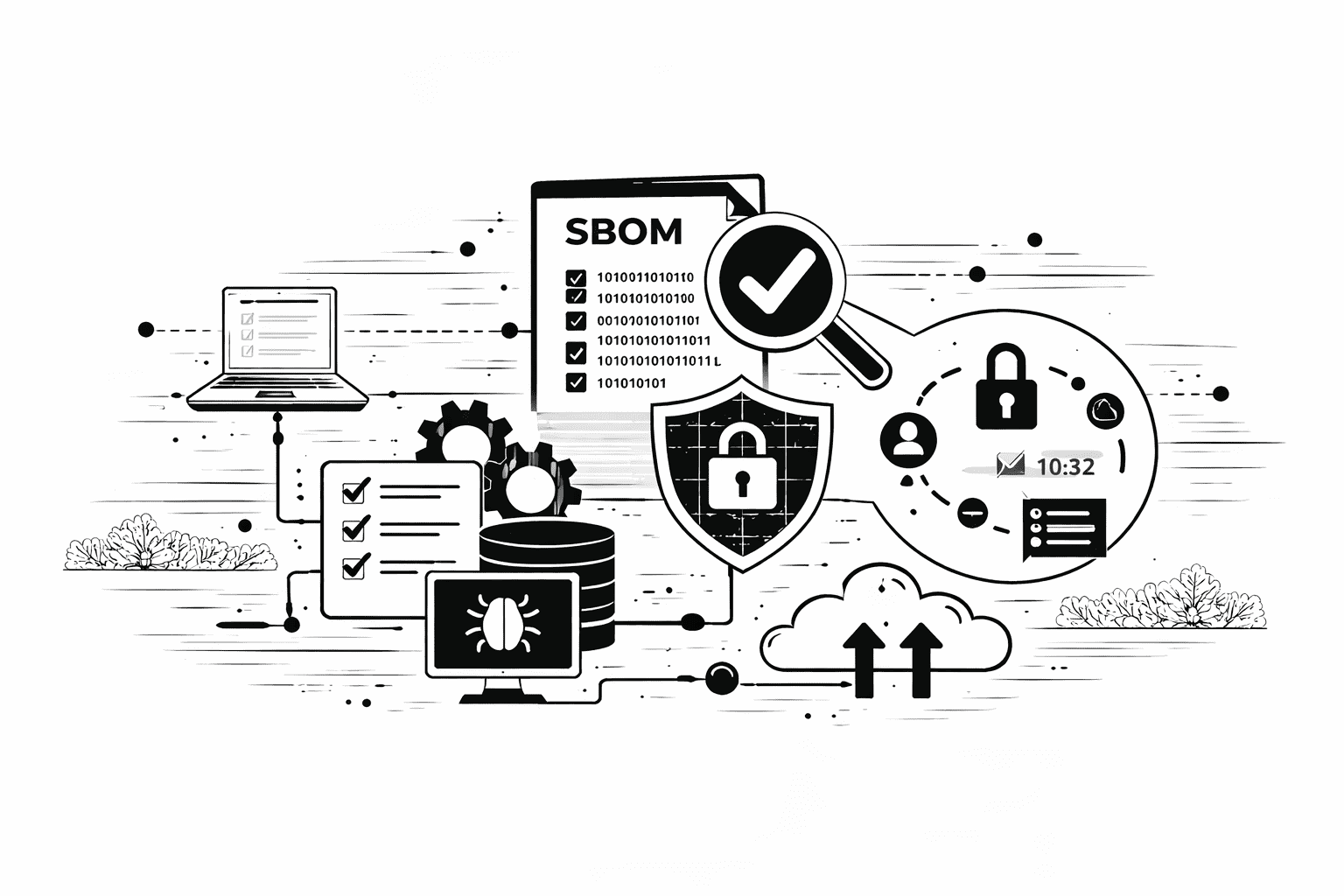
Software teams keep getting told to “produce SBOMs.” So they do: they generate a file, attach it to a ticket, send it to a customer, and move on.
And then the real world hits.
A new vulnerability drops. A customer asks for proof of what version you shipped. A regulator wants traceable evidence. A supplier sends an SBOM that’s incomplete, stale, or formatted in a way your team can’t reliably validate. Suddenly the SBOM isn’t “documentation” anymore, it’s the difference between knowing and guessing what’s inside your software.
That’s the core mistake most SBOM efforts make: treating an SBOM as a static artifact instead of what it actually needs to be - a control system for software supply chain risk.
“So… are you basically a document management platform for SBOMs?”
A couple of weeks ago, a customer asked us a question that was both fair, and revealing:
“So… is Exodos Labs basically a document management platform for SBOMs?”
I get why they asked. A lot of the market still treats SBOMs like files:
- upload here
- download there
- forward to a supplier
- attach to a compliance ticket
- call it a day
If that’s your mental model, “SBOM management” sounds like document management.
But that’s exactly the trap.
Because when an SBOM is just a document, it behaves like a document:
- it gets emailed around
- it goes stale
- it loses its connection to what actually shipped
- it has no enforceable standards
- and nobody can prove who shared what, when, and why
So here’s the answer we gave, and it’s the lens for this entire blog series we're starting today:
Exodos Labs is not a document management platform.
We’re building a control system for SBOM operations across the software supply chain.
A document system helps you store artifacts.
A control system helps you trust them, and act on them under pressure.
That means we’re not optimizing for “where do you put SBOM files?”
We’re optimizing for the questions that show up when it matters:
- Which SBOM maps to the exact build that shipped?
- Did it meet our minimum acceptance criteria (quality gate)?
- Can we safely share it with the right party, with least disclosure?
- Can we prove what we shared and maintain an audit trail?
- Can we monitor changes and respond fast when a new vuln drops?
If you’ve ever scrambled during an incident or audit, you know why this matters: the painful part isn’t producing a file, it’s building a workflow that creates repeatable trust.
The hidden failure mode: “SBOM chaos”
Here’s what “SBOM chaos” looks like in practice:
- SBOMs live everywhere: build pipelines, a shared drive, email attachments, Jira tickets, a vendor portal.
- The same product has multiple SBOMs, but nobody can answer which one maps to the build that shipped.
- Updates happen, but SBOMs don’t - so “freshness” becomes a guess.
- Supplier SBOMs arrive inconsistent: missing fields, unclear component identifiers, questionable timestamps, unknown provenance.
- When an incident happens, the SBOM doesn’t reduce uncertainty, it adds another dataset to reconcile.
This is why SBOM generation alone doesn’t move the needle.
Generation answers: “Can we output an SBOM?”
Operations answers: “Can we rely on it when it matters?”
SBOM chaos isn’t a tooling problem. It’s a lifecycle problem.
The reframe that scales: SBOM as a control loop
In regulated environments, “having documentation” is not the same as “having control.”
Control means:
- you can trust the data
- you can prove where it came from
- you can show what changed
- and you can reproduce decisions later
That’s why the SBOM needs to be treated less like a file and more like a living, governed inventory.
A practical SBOM program behaves like a control loop with four pillars:
1) Versioning + provenance: tie SBOMs to what you actually ship
If you can’t tie an SBOM to a specific build or release, you can’t use it in an incident, audit, or customer escalation.
Minimum capabilities you need:
- SBOMs linked to product + version + build metadata
- a history of changes over time (diffs matter)
- clear provenance: who created it, using what process, and when
- the ability to answer: “Which SBOM corresponds to the shipped artifact?”
Here’s the uncomfortable truth:
If your SBOM can’t survive the question “what exactly shipped?”, you don’t have visibility, you have an export.
2) Quality gates: prevent “garbage SBOMs” from becoming official
Most SBOM compliance failures are quality failures:
- missing component identifiers
- incomplete dependency trees
- inconsistent licensing fields
- unclear scope (what’s included vs excluded)
- no timestamps, no supplier attribution, no confidence
A quality gate turns SBOMs from “we generated something” into “we can rely on this.”
Start with a simple gate:
- schema validation (format correctness)
- minimum field requirements (e.g., baseline elements)
- organizational acceptance criteria (your own needs, per product line or regulation)
Quality gates aren’t about perfection. They’re about trust.
If you allow incomplete SBOMs into your “source of truth,” you’ll find out at the worst possible moment: during a vulnerability event, a customer audit, or a regulatory request.
3) Secure exchange: sharing SBOMs without creating new risk
SBOM sharing is where good intentions break:
- Customers want transparency.
- Suppliers fear over-disclosure.
- Legal worries about IP leakage.
- Security worries about oversharing attack surface.
So teams fall back to the default: emails, one-off uploads, ad hoc portals, and “can you resend that file?”
That kills auditability and creates secondary risk.
A controlled approach looks like:
- role/attribute-based access (who can see what)
- least-disclosure sharing (only what’s needed for that counterparty)
- audit trails (who accessed, shared, downloaded, or updated what)
- structured workflows (requests, approvals, SLAs, escalation paths)
If SBOMs move through uncontrolled channels, you can’t prove what you shared — or why.
And in many regulated contexts, “we emailed it” is not an acceptable control.
4) Monitoring + evidence: SBOM programs exist for high-pressure moments
When a new vulnerability appears, the question isn’t “do we have SBOMs?”
It’s:
- Can we answer quickly and defensibly?
- Can we prove we did the right thing?
- Can we communicate impact and remediation clearly?
That requires:
- a centralized SBOM inventory you can query
- vulnerability and license context connected to components
- “what changed since last release” visibility
- evidence logs that hold up in audits and customer reviews
If your SBOM process doesn’t speed up incident response, it isn’t operational yet.
A simple maturity model: from paperwork to control
A helpful way to self-assess:
Level 0 — Ad hoc
SBOMs exist as PDFs or files when someone asks.
Level 1 — Generated
SBOMs are produced in CI/CD, but not governed or centralized.
Level 2 — Centralized
SBOMs live in one inventory with validation and basic quality checks.
Level 3 — Controlled exchange
Suppliers/customers share via auditable workflows with access control.
Level 4 — Continuous
Monitoring, evidence, and “always audit-ready” reporting are baked in.
Most teams sit at Level 1. The biggest gains happen moving to Level 2–3.
What you can do this week: a 7-day quickstart
If you want to get out of SBOM chaos quickly, focus on the smallest set of controls that create trust:
- Write SBOM acceptance criteria
Define minimum required fields, supported formats, and fail conditions.
- Centralize SBOM storage
Create one source of truth (not email/tickets/shared drives).
- Add a quality gate
Validate schema + enforce completeness before SBOMs are “official.”
- Link SBOMs to releases
Ensure SBOMs are tied to product/version/build metadata.
- Create a supplier request workflow
Who requests? How is it tracked? What’s the SLA? What’s escalation?
- Decide sharing rules
Least disclosure, access control, and auditable delivery.
- Assign ownership
“Everyone” owning SBOMs means nobody owns them. Decide who is responsible for what.
You don’t need a perfect program. You need one that holds up under pressure.
The point isn’t more SBOMs - it’s less uncertainty
If SBOMs only exist as files, you don’t have supply-chain visibility. You have supply-chain paperwork.
A real SBOM program behaves like a control loop:
- SBOMs are versioned and tied to what you ship
- They pass quality gates before anyone relies on them
- They’re shared through controlled collaboration, not email attachments
- And they produce audit-ready evidence when the stakes are high
The goal isn’t “generate more SBOMs.” The goal is reduce uncertainty. For your engineers, your customers, and your auditors.
Next in this series
Next up: SBOM lifecycle 101 — Generate → Store → Validate → Share → Monitor
…and the failure points that break each step.
Want to operationalize this without adding busywork?
Exodos Labs helps teams centralize SBOM inventory, enforce quality gates, and exchange SBOMs securely with suppliers and customers - with full auditability. (Start Free Tier / Request an Enterprise Trial)