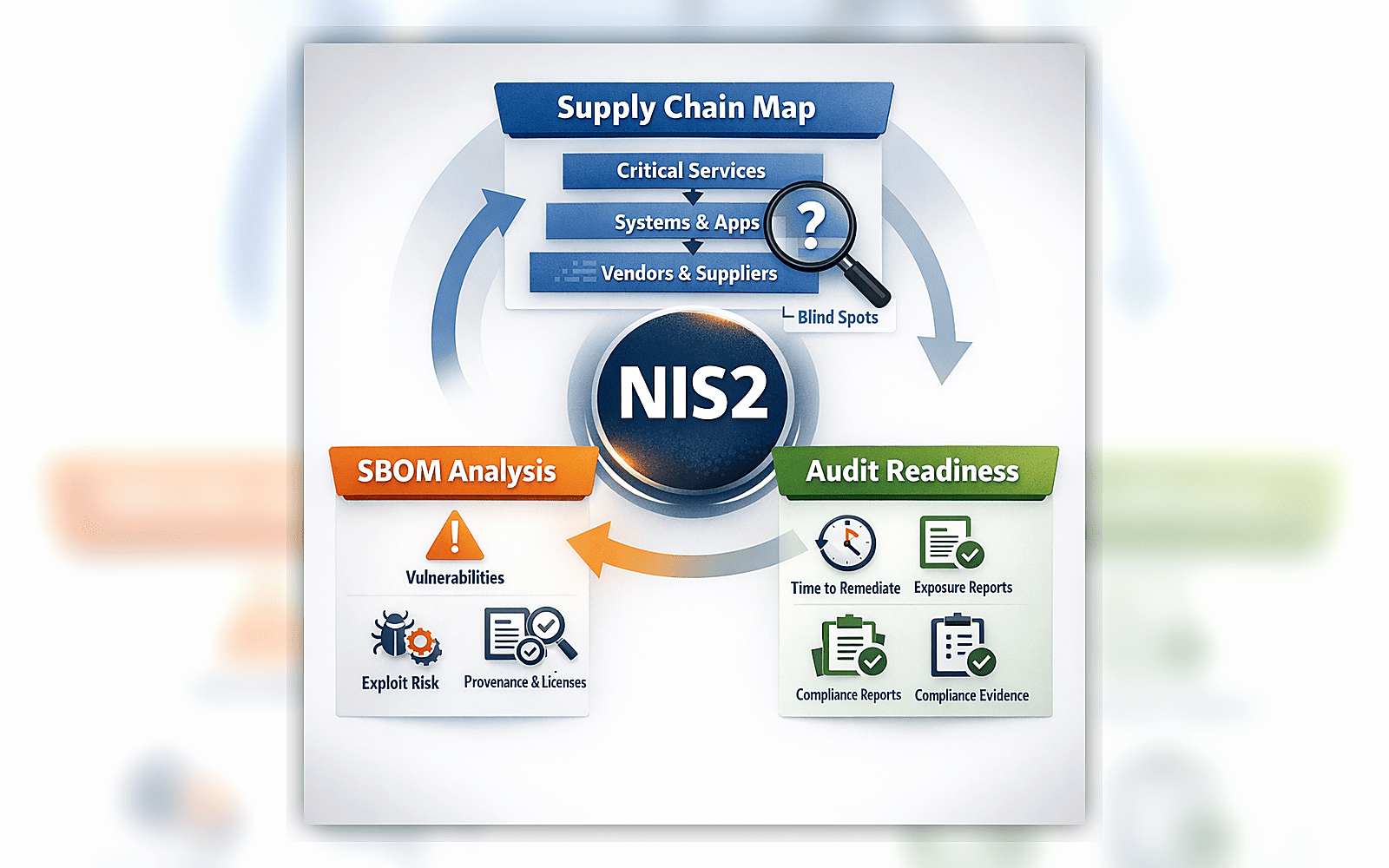
How EU essential and important entities can turn “supply chain security” into repeatable operational practice - without drowning in paperwork.
Executive framing: what NIS2 really changes NIS2 pushes software supply chain security out of the “policy layer” and into operational reality. It’s no longer enough to say we assess suppliers or we manage risk. Under incident pressure - or in an audit - you need to prove you know what software runs where, who is responsible for it, and how fast you can respond when the supply chain breaks.
NIS2 doesn’t name SBOMs explicitly. But it does require outcomes that are almost impossible to achieve at scale without SBOM-driven visibility: faster impact analysis, credible supplier governance, and evidence you can stand behind.
Key point: NIS2 maturity is less about having a document, and more about having repeatable answers.
The three questions your board (and regulator) will expect you to answer
If you simplify the whole topic, it comes down to three questions:
-
What are we actually running in critical systems—right now?
-
Who builds and maintains it—and what dependencies are we inheriting?
-
How quickly can we determine exposure and act when vulnerability X hits?
Your “NIS2 supply chain program” succeeds or fails based on how reliably you can answer these—especially under time pressure.
Step 1: Start with a minimum viable supply chain map
Before you ask suppliers for SBOMs, you need to map your own landscape. Not perfectly. Just enough to stop flying blind.
What to map (keep it simple)
Start with your critical services and work downwards:
-
Critical services (the things that truly matter to operations, safety, or regulated obligations)
-
Supporting systems (the platforms and applications those services depend on)
-
Software components (vendor products, in-house apps, open source stacks, managed services)
-
Supplier relationships (who provides what, who updates it, and where you lack visibility)
What “good enough” looks like
A first-pass map is successful if it gives you:
-
named ownership (someone can answer questions)
-
visibility into third-party dependence (where updates come from)
-
an explicit list of “blind spots” (unknowns you’ll close over time)
Practical tip: Don’t try to map everything. Map the things you would have to explain to leadership in a serious incident.
Step 2: Decide where SBOMs create real value (and where they don’t)
One reason SBOM programs fail is that teams try to treat every component equally. That leads to bureaucracy and vendor pushback.
Instead, use a tiered approach: SBOM depth should follow risk.
A simple tier model
| Tier |
Typical scope |
SBOM expectation |
Why it matters |
| Tier 1 (highest) |
Internet-facing, privileged systems, safety-impacting, OT/embedded with slow patching |
Per release (or continuous), machine-readable |
Fast impact analysis + credible audit posture |
| Tier 2 |
Core business apps, widely deployed systems |
Per release or periodic, with change tracking |
Reduces exposure windows, supports governance |
| Tier 3 (lowest) |
Non-critical internal tools |
On request / lightweight |
Keeps overhead proportionate |
If you only implement one thing: enforce Tier 1 requirements for your most critical systems. That alone shifts your posture dramatically.
Step 3: Make SBOMs a procurement and contracting topic - not an incident topic
If you ask for SBOMs only when you’re already under attack, you’ve already lost the timing advantage.
What to do in the supplier lifecycle
During selection (RFP / due diligence)
- Can the supplier produce SBOMs (format, cadence, delivery method)?
- Are SBOMs product-level or deployment-specific?
- Can they provide meaningful vulnerability communication (and not just generic advisories)?
During contracting
- Define SBOM expectations (format + cadence + access)
- Define vulnerability expectations (SLA for critical issues, escalation path, notification obligations)
- Clarify sub-supplier responsibility (who is accountable for transitive dependencies)
During operations
- Review SBOM delivery reliability (are they consistent?)
- Track supplier responsiveness during security events
- Keep evidence of communication and remediation
The mindset shift: You’re not “punishing suppliers.” You’re building them into your resilience story—with measurable expectations.
Step 4: Convert SBOMs into decisions leaders can support
An SBOM is just structured data. The value comes from what you do with it.
Once SBOMs exist for Tier 1/2 systems, your security program can stop arguing from intuition and start arguing from facts.
What to enrich SBOMs with
- known vulnerabilities and severity
- exploitability signals and vendor statements (where available)
- provenance indicators (where components came from, how trustworthy the chain is)
- remediation status and timelines
The metrics that actually land with senior stakeholders
Skip complicated scoring models. Use explainable metrics that map to operational resilience:
- Time to impact analysis: How fast can you answer “are we affected?”
- Exposure window: How long do critical issues remain open in Tier 1 systems?
- Supplier reliability: Which suppliers consistently deliver complete SBOMs and respond quickly?
- Unknown provenance ratio: Where do you have components you can’t confidently trace?
These are board-usable because they connect security reality to operational risk.
Step 5: Build an audit narrative based on evidence, not intention
Audits tend to get uncomfortable when organizations have “policy” but not “proof.” The good news: once you’ve done Steps 1–4, audit readiness becomes a byproduct.
Here are the audit questions you should plan for:
- “Show how you assess software suppliers.”
- “Show how you know which systems are affected by vulnerability X.”
- “Show how you track remediation over time.”
- “Show how this is governed—and how you can prove it.”
If your answers are backed by timestamps, ownership, and repeatable workflows, you’re not just compliant—you’re credible.
A pragmatic rollout plan (30 / 60 / 90 days)
Use this to make the program feel achievable and non-theoretical.
| Timeframe |
Focus |
Outputs you should have |
| 0–30 days |
Foundation |
Tier 1 scope, ownership, minimum viable supply chain map, SBOM requirements draft |
| 31–60 days |
Operational intake |
Tier 1 supplier outreach, SBOM intake workflow, first impact-analysis drill |
| 61–90 days |
Governance + proof |
Basic KPIs, evidence repository, mock audit, contract amendments for key suppliers |
Where Exodos Labs fits
If you’re NIS2-exposed, the practical challenge isn’t understanding the directive—it’s operating the evidence loop continuously.
Exodos Labs supports that loop by:
- acting as a registry for internal and third-party SBOMs
- enriching SBOMs with vulnerability, license, and provenance signals
- providing audit-ready reporting and supplier tracking
- supporting SBOM-driven communication when issues arise
Closing: the NIS2 supply chain program that actually works
NIS2 is not asking you to collect more documents. It’s asking you to prove—under pressure—that you understand and can govern the software supply chain your critical services depend on.
Start with a map. Tier your expectations. Put SBOM requirements into supplier lifecycles. Convert SBOMs into action and evidence. Do that consistently, and compliance becomes the natural output of operational maturity.