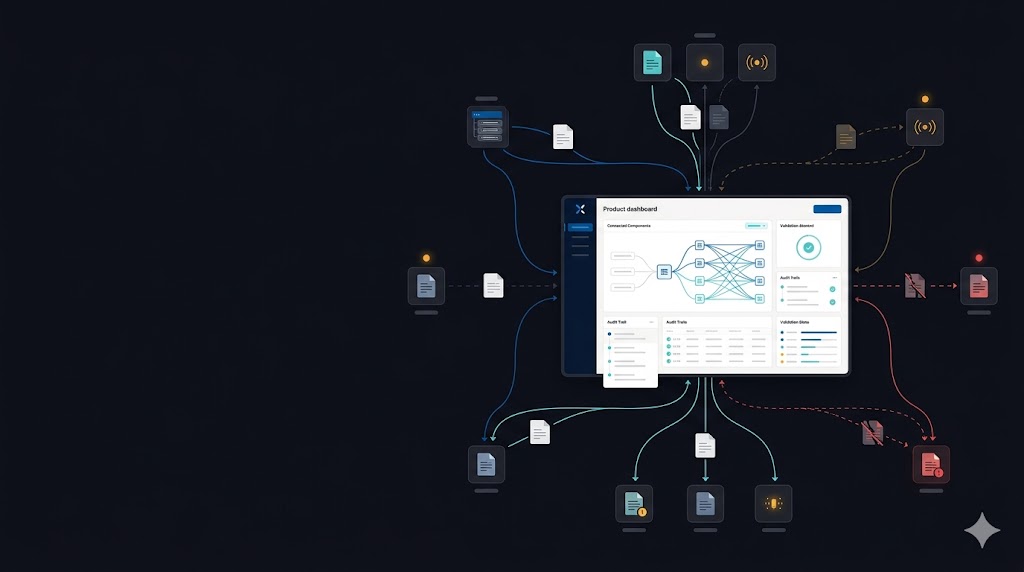
Most companies think the hard part is asking a supplier for an SBOM.
It is not.
The hard part starts after the request leaves your inbox.
One supplier sends a CycloneDX file. Another sends SPDX. Another sends a PDF that is not an SBOM at all. One supplier says the SBOM is confidential. One asks for an NDA. One sends a file but strips out the useful component data. One ignores the request until procurement escalates. Another sends last year's build and calls it current.
Then a vulnerability drops.
Now the question is no longer, "Do we have an SBOM?"
The question is:
Can we prove which suppliers are affected, which products are exposed, who responded, what they shared, what they redacted, what they promised, and what still needs action?
That is where most supplier SBOM programs break.
The Supplier SBOM Problem Is Not About Files
SBOM conversations often start in the wrong place. Teams debate SPDX versus CycloneDX, which scanner to use, or whether SBOMs should be generated in CI/CD.
Those questions matter. But for supplier risk, they are not enough.
Supplier SBOM management is an operating model problem. It touches procurement, product security, legal, compliance, engineering, and incident response.
The real workflow looks like this:
-
Identify which suppliers need to provide SBOMs.
-
Request SBOMs with clear expectations.
-
Track who responded and who did not.
-
Validate whether the SBOM is complete and machine-readable.
-
Decide what data can be shared or redacted.
-
Monitor submitted SBOMs continuously.
-
Re-contact affected suppliers when new vulnerabilities emerge.
-
Preserve an audit trail for regulators, customers, and internal governance.
If that process lives in email, spreadsheets, procurement notes, and one-off security tickets, it will fail under pressure.Not because the team is careless.Because the process was never built for scale.
The First Failure Mode: No One Knows Who Has Responded
The simplest supplier question is often the hardest to answer:
Which suppliers have actually provided usable SBOMs?
In many organizations, the answer is spread across inboxes. Someone in procurement has the contract thread. Someone in product security has the SBOM attachment. Someone in legal has the NDA. Someone in engineering has the Jira ticket. Someone else has the updated file from last quarter.
That is not supplier governance. That is institutional memory.
And institutional memory does not survive audits, incidents, turnover, or scale.
A mature supplier SBOM workflow needs a system of record:
-
which supplier was asked;
-
what product or component the request covers;
-
which SBOM version was received;
-
which format was used;
-
whether the SBOM passed quality checks;
-
what was redacted;
-
which policy applied;
-
who approved access;
-
and what follow-up is still open.
Without that, an SBOM request is just another email.
The Second Failure Mode: The SBOM Arrives, But It Cannot Be Used
A supplier can technically send an SBOM and still fail the security test.
Common problems include:
-
missing component versions;
-
incomplete transitive dependencies;
-
inconsistent package names;
-
missing license data;
-
no supplier or author metadata;
-
no generation timestamp;
-
no relationship data;
-
stale files from old releases;
-
formats that are technically valid but operationally useless.
This is why "we received the SBOM" is a weak metric.
The better metric is: Can a machine use this SBOM to answer risk questions?
For example:
-
Does this supplier ship a vulnerable component?
-
Is the affected component used in a product we distribute?
-
Is the vulnerability exploitable in this context?
-
Has the supplier issued VEX or remediation guidance?
-
Is the same component present across multiple suppliers?
-
Does the SBOM meet our quality policy?
-
Can we show the evidence later?
-
If the SBOM cannot support those questions, it is not control infrastructure. It is paperwork.
The Third Failure Mode: Suppliers Do Not Want To Share Everything
This is where many SBOM programs hit a political wall.
Suppliers may accept the idea of transparency in principle. But in practice, they worry about exposing intellectual property, sensitive architecture, internal component choices, or security weaknesses.
That concern is real.
The answer is not to force every supplier to publish everything to everyone. The answer is controlled disclosure.
A serious supplier SBOM exchange process needs policy-driven sharing:
-
what can be public;
-
what requires authentication;
-
what requires an NDA;
-
what should be redacted;
-
what can be shared with a customer;
-
what can be shared with an auditor;
-
and what should stay internal.
This is where email becomes dangerous. Once an SBOM leaves as an attachment, control is gone. There is no durable access policy, no clean revocation path, and no reliable record of who saw what.
Supplier SBOM exchange needs to work more like a controlled trust workflow than a file transfer.
The Fourth Failure Mode: Incidents Turn One-To-One Work Into Chaos
Supplier SBOM programs often look manageable until the first real incident.
Imagine a new critical vulnerability appears in a widely used open-source component. You now need to know:
-
which internal products include it;
-
which supplier products include it;
-
which suppliers have already provided SBOMs;
-
which suppliers need to be contacted;
-
which suppliers are affected;
-
which suppliers say they are not affected;
-
which suppliers have issued VEX;
-
which customers need updates;
-
and which deadlines apply.
If every supplier conversation happens separately, your team becomes a manual routing engine.
That does not scale.
The better model is an incident workspace connected to supplier SBOM data. The platform should identify affected suppliers, trigger the right outreach, track responses, and preserve the record.
This matters because supply-chain incidents are not single-threaded anymore. One vulnerable component may cut across dozens of products and hundreds of vendors.
The organization that can answer quickly will look controlled.
The organization that starts searching inboxes will look exposed.
Regulation Is Turning Supplier SBOMs Into Evidence
The Cyber Resilience Act entered into force in December 2024. The European Commission states that the main CRA obligations apply from 11 December 2027, while reporting obligations apply from 11 September 2026.
That date matters because reporting requires operational readiness before full conformity deadlines arrive.
You cannot report effectively if you cannot identify affected products, trace supplier exposure, and coordinate remediation.
Supplier SBOMs become part of that evidence chain.
They help answer:
-
what software is in the product;
-
which supplier provided which software;
-
what vulnerabilities are known;
-
what actions were taken;
-
when suppliers were contacted;
-
what response was received;
-
and whether the manufacturer had a reasonable process in place.
For regulated manufacturers, supplier SBOM management is not a nice-to-have. It is becoming part of product cybersecurity governance.
What A Mature Supplier SBOM Workflow Looks Like
A mature workflow has five layers.
First, supplier inventory. You need to know which suppliers matter for which products, business units, and risk categories.
Second, structured SBOM requests. Every request should have a scope, expected format, due date, policy, and owner.
Third, quality validation. The system should check whether an SBOM is complete, current, and usable before anyone treats it as evidence.
Fourth, controlled exchange. Suppliers should be able to share data under clear access rules, including redaction and NDA-gated disclosure where needed.
Fifth, continuous monitoring and incident response. Once an SBOM is received, it should not sit still. It should be monitored against vulnerabilities, license issues, geo-risk, and policy changes.
This is the difference between "we collect SBOMs" and "we manage supplier software risk."
The Board-Level Question
The board does not need to understand every SBOM format.
But it should ask one operational question:If a critical vulnerability is disclosed tomorrow, can we prove which suppliers are affected and what we did about it?
If the honest answer is no, the supplier SBOM program is not ready.
The fix is not another spreadsheet.
The fix is a supplier SBOM exchange layer that turns files, requests, approvals, policies, vulnerabilities, and responses into one governed workflow.
Because in 2026, the supplier who cannot send a usable SBOM is not just slow.
They are already part of your risk surface.
Recommended Next Step
Map your top 25 software-relevant suppliers and ask three questions:
-
Do we have a current SBOM from them?
-
Has it passed quality validation?
-
Can we re-contact them quickly if a new vulnerability affects their software?
If any answer depends on searching someone's inbox, the process is not ready for regulation, customer pressure, or incident response.
CTA: Build this as a governed workflow with Exodos Secure SBOM Exchange.
Sources
ENISA: SBOM Adoption State of Play 2026: https://www.enisa.europa.eu/publications/sbom-adoption-state-of-play-2026