AI coding tools are changing how software gets built.
They help developers move faster, generate boilerplate, explore unfamiliar frameworks, and solve implementation problems with less friction.
But they also change the risk model.
AI does not make open source disappear.
In many cases, it makes open-source consumption easier, faster, and less visible.
That matters because most organizations already struggle to understand their dependency graph. AI-assisted development can widen that gap.
AI Does Not Replace Open Source. It Routes Developers Toward It.
There is a tempting assumption that AI-generated code will reduce dependence on open-source packages.
In practice, that is not how modern development usually works.
When a developer asks an assistant to solve a problem, the answer often includes a library, framework, package, SDK, or example built around existing ecosystem conventions.
That is logical. Open-source packages encode years of community knowledge. They are easier to recommend than writing and maintaining everything from scratch.
The result is not less open source.
The result is faster discovery and adoption of open source.
That can be good for productivity.
It can also be risky if the organization cannot see what is being adopted.
The Attack Surface Expands In Small Decisions
Open-source risk rarely enters through a dramatic event.
It enters through small, routine decisions:
- a package added to solve a build issue;
- a transitive dependency introduced by a framework;
- an abandoned library suggested in an example;
- a package with a similar name to a trusted component;
- a dependency maintained by one person;
- a component with unclear provenance;
- a license that creates obligations;
- a library used in a prototype that later becomes production.
AI can accelerate these decisions.
The problem is not that AI is malicious.
The problem is that AI can make dependency inclusion feel effortless.
When inclusion becomes effortless, governance has to become more automated.
Manual Review Cannot Keep Up
AppSec, legal, and compliance teams were already overloaded before AI coding became mainstream.
They had to review vulnerabilities, licenses, supplier software, customer questionnaires, and release exceptions.
AI increases development throughput, but it does not automatically increase review capacity.
That creates a gap.
Engineering moves faster.
Review workflows remain manual.
Dependencies enter faster than teams can evaluate them.
The organization then faces a bad choice:
- slow engineering down with heavy approval gates;
- allow risk to accumulate silently;
- or automate visibility, policy, and response.
Only the third option scales.
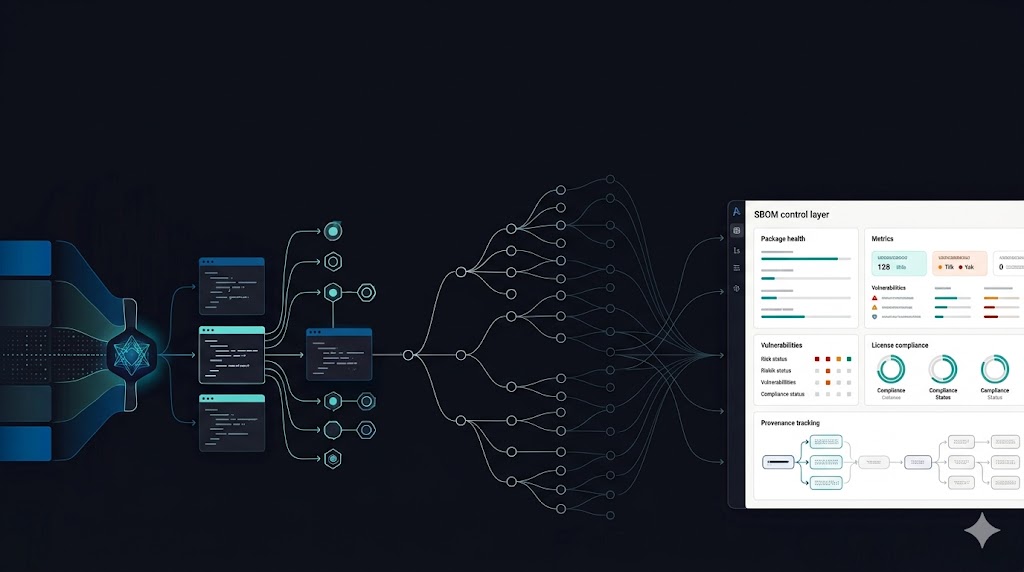
SBOMs Become The Control Layer
An SBOM is not a magic shield against AI risk.
But it gives the organization a structured way to regain visibility.
If every meaningful build produces a high-quality SBOM, teams can see:
- which packages were included;
- which versions were used;
- which dependencies are transitive;
- which licenses apply;
- which vulnerabilities exist;
- which components are newly introduced;
- which maintainers or projects look risky;
- and which products are affected.
That visibility is the foundation.
Without it, AI-assisted development becomes difficult to govern because the organization cannot reliably see what changed.
The New Question: Who Chose This Dependency?
AI also blurs accountability.
In traditional development, a developer deliberately selects a dependency, adds it, and commits it.
With AI assistance, the selection path may be less obvious.
The developer may accept a suggestion. The suggestion may include a package. The package may introduce transitive dependencies. The final code may work, but the dependency rationale may never be documented.
When a vulnerability appears later, teams need to reconstruct context:
- why was the package added?
- where is it used?
- is it still needed?
- is there a safer alternative?
- who owns remediation?
- can we replace it without breaking the product?
SBOMs do not answer every question, but they make the investigation possible.
They create the map.
Package Health And Maintainer Risk Matter More
AI coding tools can recommend packages that appear common, convenient, or syntactically appropriate. But security teams need deeper context.
They need to know whether a package is healthy.
Useful signals include:
- maintainer activity;
- contributor concentration;
- release cadence;
- known vulnerabilities;
- suspicious ownership changes;
- license changes;
- project abandonment;
- package registry signals;
- and geo-risk or provenance indicators.
This is where SBOM data needs enrichment.
A component list is useful.
A component list connected to maintainer, vulnerability, license, and provenance intelligence is much more powerful.
AI-era development makes that enrichment more important because package decisions happen faster.
AI Recommendations Need Policy Boundaries
The next stage is not just detecting risk after the fact.
It is guiding better choices before and during development.
For example:
- do not use packages that fail health policy;
- flag components with high-risk licenses;
- prefer packages with active maintainers;
- suggest alternatives for vulnerable dependencies;
- block known malicious or typosquatted packages;
- require review for sensitive product lines;
- restrict components from certain risk categories;
- route exceptions to the right owner.
This is where SBOM management connects to AI-native workflows.
The goal is not to stop developers from using AI.
The goal is to give AI-assisted development a control system.
Why Traditional Scanning Is Not Enough
Traditional scanning finds issues, but AI-era risk requires more than point-in-time detection.
Teams need:
- continuous monitoring after release;
- history of which products contained which components;
- policy-based quality gates;
- license and FOSS notice workflows;
- supplier component visibility;
- incident response coordination;
- and evidence for regulators or customers.
AI increases the speed of software change.
Static scanning does not solve the governance problem by itself.
An organization needs a live software supply-chain graph.
That graph should connect code, SBOMs, suppliers, products, vulnerabilities, licenses, maintainers, incidents, and policies.
Then AI tools can operate with context instead of guesswork.
The Buyer Trust Angle
AI-assisted development will also affect customer conversations.
Enterprise buyers will increasingly ask:
- How do you govern AI-generated code?
- How do you prevent unsafe dependencies?
- Can you produce SBOMs for shipped products?
- Can you explain open-source risk?
- Can you show vulnerability response evidence?
- Can you disclose components safely?
Vague answers will not be enough.
"Our developers are careful" is not a control.
"We have a scanner" is not the full answer.
A stronger answer is:
We generate and manage SBOMs continuously, validate quality, monitor vulnerabilities, evaluate license and maintainer risk, enforce policies, and preserve evidence across releases.
That is the level of maturity regulated buyers will expect.
What To Do Now
Start with the workflows where AI can silently expand risk:
- new package adoption;
- prototype-to-production paths;
- generated code accepted into critical services;
- dependency updates;
- open-source license review;
- supplier-provided code;
- and customer-facing product releases.
Then connect those workflows to SBOM generation and policy checks.
At minimum, teams should know:
- what changed in the dependency graph;
- which new components entered;
- whether they pass policy;
- whether licenses require action;
- whether vulnerabilities exist;
- and whether safer alternatives are available.
That is the foundation for AI-era software supply-chain control.
The Strategic Point
AI coding tools are not the enemy.
Unmanaged dependency growth is the enemy.
Companies that combine AI development with SBOM-based governance will move faster and stay controlled.
Companies that adopt AI without software supply-chain visibility will move faster into uncertainty.
The difference will show up in incidents, audits, customer trust, and regulatory readiness.
Recommended Next Step
Choose one team using AI coding tools and run a dependency-change review:
- Compare SBOMs across recent builds.
- Identify newly introduced packages.
- Check vulnerability, license, and package health signals.
- Review whether AI-assisted work introduced dependencies without explicit discussion.
- Define policy gates for future package adoption.
This gives the organization a concrete view of AI-driven dependency drift.
CTA: Book an Exodos platform demo to see how SBOM automation, policy, package intelligence, and MCP/AI workflows create a control layer for modern software development.
Sources